Showing posts with label Community. Show all posts

Monday, September 3, 2012

Hurricane as Opportunity

   Over the past week I've been suffering in my hot box of an apartment wondering about when Entergy, the local power monopoly, would restore power and start charging me for the electricity I desperately needed. While my power was out and my apartment felt like the Satan's armpit, I decided to venture out into the world, interact with other sweaty humans, as well as survey the damage to other people's cars and homes in a vain attempt to feel better about my own situation. Unexpectedly, however, I noticed that some businesses which also didn't have power were serving customers. The sight of a waiter drenched in sweat serving tapas to a customer, who also seemed to have jumped into a pool before sitting down to eat, inspired this blog entry.

   An important part of the entrepreneurship equation and a skill that differentiates great entrepreneurs from former entrepreneurs is the ability to identify and take advantage of opportunities. Opportunities emerge from a complex pattern of changing conditions and can be leveraged if an individual or organization is primed to fulfill a need, address a pain, or quickly fill a gap. JFK famously said in a speech delivered in Indianapolis in 1959 that "...when written in Chinese the word crisis is composed of two characters.One represents danger, and the other represents opportunity." While linguists have criticized the incorrect translation of wēijī, his point is well taken. A crisis, such as the weather event and aftermath we just experienced in New Orleans can be tragic, can trigger anxiety, remind folks of sad memories of a recent past, but it can also be an opportunity. It is, after all, a stark break in everyone's daily routine that can lead even the most regimented individual to see the world around her in a new light, to notice an open ice cream parlor they had never noticed before, to shop at a local mini mart, etc.

   Some New Orleans businesses were masterful in how they turned a few days of lost power into a chance to attract new customers and create deeper relationships with customers that had no choice but to come to them for a break from the monotony of their newly medieval homes. Slim Goodies Diner, on Magazine near Louisiana, took their red booths out of their restaurants and into the street and created a limited menu. I got eggs, bacon and hash. A few of the restaurants that didn't lose power in the CBD welcomed patrons from Uptown and Mid-city that they might have never seen before. I was surprised to find Carmo, a Brazilian fusion restaurant and bar on Julia St. with lots of vegan options, open and serving dinner just a few hours after the heaviest rains stopped coming around. I had a Feijoada for the first time in a long time. Even the restaurants that struggled to open or were partially opened were lauded by their patrons and Facebook followers: http://www.inthenola.com/news/nola-living/item/3704-ten-things-we-learned-from-hurricane-isaac.html

Booths at Slim Goodies Diner

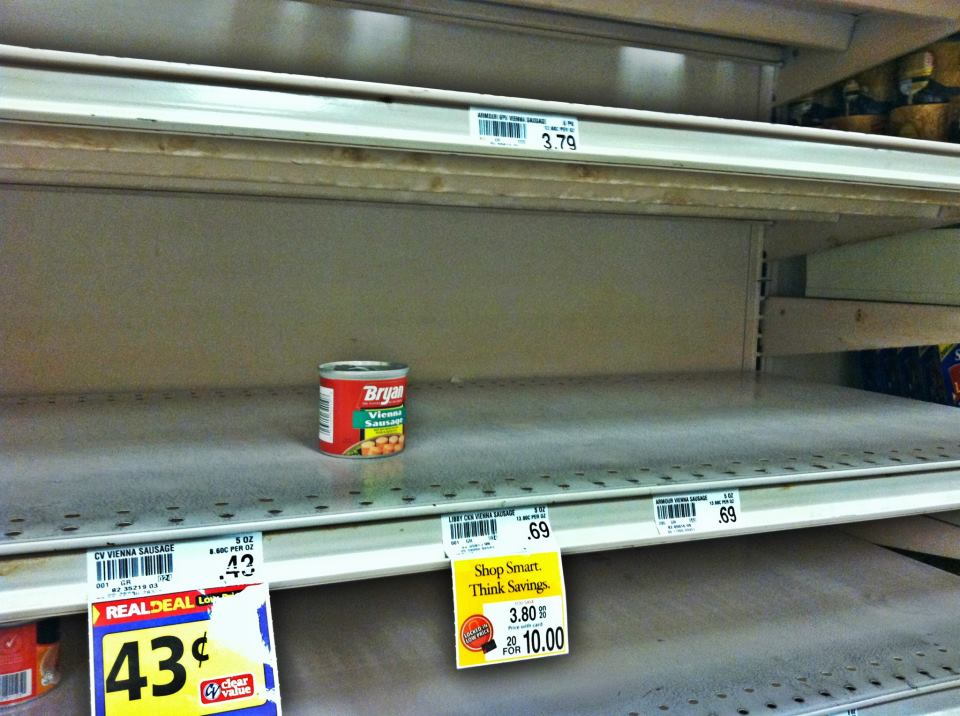
   Other restaurants, particularly the chain restaurants and those too new to have a dedicated waitstaff, remained closed and missed out on a hungry and adventurous clientele that would have loved anything they ate after eating Vienna Sausages (see image below) for three days straight.

Source: Dramatic Hurricane Isaac Updates Facebook Group

Saturday, August 25, 2012

Little Free Libraries for Hipster Literacy

The other day I was walking around mid-city when I ran into this:


This person's actual house was very colorful

This box and many others like it contain books that are free for you to borrow - no late fees, library cards or interactions with people. The brainchild of Hudson, Wisconsin social entrepreneur Tod Bol, Little Free Libraries are one solution to promote literacy and community. These little libraries can be found in Canada, Mexico, Australia and even Afghanistan. The goal of the movement is to surpass the number of libraries built by white beard aficionado and really rich dude Andrew Carnegie (a record 2,510).


I think he likes you
My two cents:

  • Not sure if just putting books in a box in front of your house will genuinely lead to higher levels of literacy. Perhaps donating your time or money to book clubs and public school might be a more plausible strategy. I do believe it a great strategy to increase hipster and yuppie DIY skills. 
  • The boxes are cool-looking and I think it is a good way of making other people think you don't vote republican without a gaudy sign. 

Saturday, August 18, 2012

The Case of the Coveted Water Meter Cover

   Sometimes opportunities for entrepreneurship are literally laid down at your feet. As I've started getting to know New Orleans, I've begun to notice the little things that give the city its world renowned charm. Most people remember the beautiful houses along St. Charles, the iconic and noisy streetcars (no wonder he had to scream Stella so loud), or the balconies that hover over the streets of the French Quarter. I was just as interested in the little things, like the ever-present fleur-de-lis that are emblazoned all over the airport, tattooed on the locals and proudly displayed in flags hanging over awesome porches everywhere. 

The flag of the city of New Orleans has three fleur-de-lis, derived from is the yellow, 6-petaled lilies that surround the River Luts in the Netherlands. It also became a symbol of French royalty indicating divine favor.

   A less prevalent, but also very cool looking New Orleans artifact, is the water meter cover made by the Ford Meter Box Company of Wabash, Indiana (aka "the company that cares"). In1898 Edwin Ford, a superintendent of the waterworks for Hartford City, filed a patent application for the Ford Meter Box. As superintendent, Ford wanted to make sure that customers were not wasting water and costing themselves and the city money. So, in the basement of his house, Ford designed and produced the first meters and boxes. These boxes helped protect meters from the harsh Indiana winters as well as from general wear and tear. Soon, Ford agreed to supply neighboring communities with the meters. Eventually, news of the meter boxes reached Louisiana where boxes were desperately needed to protect meters - while some meters were installed in basements, the lack of basements in New Orleans and Baton Rouge called for boxes to be installed in the ground. The beautiful New Orleans meter box cover bearing the crescent moon and shining stars was designed by Edwin Ford in the early 1920s after a visit to the crescent city. By the mid twenties, nearly half the company's sales were to the City of New Orleans.

There was a time, however, when officials decided to replace the decorative covers in the CBD with plain ones to see if it would stop thieves from pilfering them.

   Over time the 9 pound meter box covers became popular with tourists and with locals. For a while, even though it is very illegal, people stole the covers as souvenirs, dragging them through airports along with other treasures. Of course, tightened airport security has made it more challenging to pull off. Others have turned the popularity of the covers into a business. Local jewelers have fashioned earrings and pendants out of the design while others have created doormats and mouse-pads. You can even find merchants selling water meter cover paraphernalia on sites like Etsy.com (http://www.etsy.com/search?q=new+orleans+water+meter&page=1&ref=related).

   It is interesting to see how Edwin Ford's entrepreneurship enabled the efforts of entrepreneurs 100 years later. It is a testament to the power of good design and to the importance of retaining the little things that give places valuable character. In fact, as I watched the closing ceremony for the Olympics in London I noticed the delegation from the Rio 2016 Olympics projected the famous Rio sidewalk designs onto the performance space. It triggered my own nostalgia and reminded me that every city has those things that make it unique.

Mosaic Sidewalk, Rio de Janeiro print by Everett

I look forward to seeing what other little things make New Orleans unique and sharing them with you. Is there anything small, quirky and charming about your city? Have entrepreneurs leveraged it for profit or charity?

Sources:
http://www.bestofneworleans.com/gambit/new-orleans-know-it-all/Content?oid=1251067

http://fineartamerica.com/featured/mosaic-sidewalk-rio-de-janeiro-everett.html

Wednesday, August 1, 2012

Keep on Food Truckin'

   Ever since I moved to New Orleans a little while ago I've been impressed with the relationship between the local community and the small businesses, particularly the restaurants, that operate within the city proper. Whether you are Uptown, in the French Quarter or in the Central Business District (known as the CBD) you have a better chance of running into full-service restaurants, po-boy shops, oyster bars and regular bars than you would any sort of chain restaurant serving all-you-can-eat salad and bread sticks or branding their staff with pieces of flair.

   The explanation (so I've been told) is that locals proudly protect this environment by visiting their favorite restaurants regularly and by trying and carefully evaluating new ones with semi-professional discernment. Those who earn the support of the locals can thrive and quickly become the topic of hundreds of conversations. A New Orleanian will talk about their dinner while eating their lunch. They will also be quick to list their favorite restaurants categorized by cuisine, neighborhood, price, and service. It turns out that you're not from New Orleans until butter and wine (and maybe a little lard) course through your veins.

   Perhaps because I've been immersed in this powerful food culture, which remains as strong as ever after Katrina, I've become fascinated with the latest drama to become the talk of the town: the food truck situation. As Micheline Maynard (@mickimaynard) explains in her article for The Atlantic (http://www.theatlanticcities.com/arts-and-lifestyle/2012/06/why-its-so-hard-be-food-truck-new-orleans/2250/), "...At a time when mobile kitchens are flourishing in so many parts of the country, prospective New Orleans food truck owners face a variety of restrictions that keep them from fanning out across the Crescent City." Basically, the City of New Orleans categorizes food trucks as mobile vendors, setting a limit on how many (about 100), where (not in the neighborhoods with any foot traffic) and how (they can't stay in one place for over 30 minutes) food trucks operate. the majority of the licenses available are taken over by non-truck vendors such as souvenir hawkers.

   This situation is, of course, not unique to New Orleans. Powerful restaurant lobbies have been fighting the potential competition from food truck tooth and nail. Chicago, L.A. and New York have all created regulations that impede food trucks from competing directly with their non-mobile counterparts. Some cities, however, have favored the little guy and worked to remove obstacles for mobile kitchens. As reason.tv shows (http://www.youtube.com/watch?v=FrMJs_DVajc&feature=player_embedded#!) food trucks remain a popular and increasingly available options for consumers in Washington D.C.

   Of course, starting a food truck is not easy, even if regulations are on your side. $15,000 to $100,000 in average startup costs and the ever-present issue of finding legal parking (particularly in large cities where operating a food truck because of sufficient food traffic) might also stand in the way of even the most dedicated mobile kitchen operator (I prefer the name food trucker or perhaps food truckie?). See http://www.openforum.com/idea-hub/topics/innovation/article/so-you-want-to-start-a-food-truck-erin-zimmer for a more detailed guide.

   Back in New Orleans, coalitions of citizens and food truckers have begun to fight city hall and seek out their piece of the foodie pie. The New Orleans Food Truck Coalition and their hungry friends have begun a hearty social media campaign (http://nolafoodtrucks.com/news/) and held several events to promote their cause.

Food Truck Coalition Banner
Source: NOFTC

   My two cents. While I'm still learning about the ins and outs of food trucking in New Orleans, I've heard a couple of things that have stuck with me:
  • Established New Orleans restaurants need not fear the food truck. Restaurants can start their own food trucks and leverage their catering experience and hard-earned skills to push out the novices. It is, in fact, an opportunity for restaurants to experiment with new locations without spending the capital (human or financial) that it takes to start a new restaurant. Moreover, opening a satellite food truck or a re-branded food truck can help some restaurants that are having trouble reaching out to a younger clientele to reach out to new demographics. 
  • The experience offered by the food truck is much different from the experience of a sit down restaurant. It is unlikely that, once the novelty wears off, a couple on a date or a family will opt for a food truck over a sit down dining experience. The restaurants that might be competing directly with food trucks are those that have crappy ambiance and don't focus on service. I might be worried, for instance, if I was a fast food joint that makes money by selling convenience - there is nothing more convenient than a truck outside your office. 
  • (added 8/8/2012) Governments too readily protect businesses they see as the "lifeblood" of a city or country. When the car industry was protected from foreign competition during the rise of the Japanese automakers, it took several years for them to recover. If New Orleans wants to maintain its advantage as an exciting food destination it should be encouraging innovation. This situation strikes as very similar to the law in several U.S. states that prevents the sale of a car on the Internet directly from a manufacturer without the participation of an dealer.
If you would like to support the New Orleans food trucks you can go to a rally or sign their petition: http://www.change.org/petitions/new-orleans-make-our-laws-friendly-to-food-trucks

If you have an opinion about whether food trucks belong or do not belong in New Orleans please post below!